We're looking for enthusiastic developers to build out API client libraries in various technologies. If you're up to the task of putting together a functioning wrapper of the Regressor.NET API in your language of choice, we'll be more than happy to hook you up with a Free Lifetime Subscription to Regressor.NET.
Guidelines
In general, you should follow the pattern set out by our flagship ASP.NET Client Library.
Here are a few things it should do:
-
Drop into a project with the minimum disruption.
So don't go building anything that requires modifying every single file, or a monumental framework that people have to plug their project into.
-
Do its thing automatically
by inserting itself somewhere in the global error handling chain in the technology in question. End users should not have to write any code to capture errors and submit them to the API.
-
Don't break anything.
Look, this is a tool that's supposed to make things better, not worse. Your code will only get called if something has already gone wrong, so don't make any assumptions that the environment will be in a stable place. Wrap everything in a giant try/catch and simply eat any exception that might try to escape.
Reporting errors is about as low priority as you can get. The last thing you want to do is divert an end user away from the developer's pretty error screen to show him a stack trace.
August 3
by
Jason Kester
Java Client Library
Overview
The Java Client Library for Regressor.NET is a small module that can be included in any project to add Automated Crash Reporting capability. Website crash data will be sent via the Regressor.NET API to the reporting server of your choice (presumably
regressor.net), where you can view statistics and configure Automated Regression testing.
Developers:
We're looking for enthusiastic developers to build out API client libraries in various technologies. If you're up to the task of putting together a functioning Java wrapper of the Regressor.NET API, we'll be more than happy to hook you up with a Free Lifetime Subscription to Regressor.NET.
Interested? Go for it then! No need to apply (or even tell us you're doing it). Just make sure you follow our API Client Library Development Guidelines so that your wrapper is consistent with the ones for all our other supported technologies.
Once you get something working, go ahead and toss it over the wall to us. If it looks good, we'll make it available to everybody and hook you up with that free license.
August 3
by
Jason Kester
PHP Client Library
Overview
The PHP Client Library for Regressor.NET is a small module that can be included in any PHP project to add Automated Crash Reporting capability. Website crash data will be sent via the Regressor.NET API to the reporting server of your choice (presumably
regressor.net), where you can view statistics and configure Automated Regression testing.
Developers:
We're looking for enthusiastic developers to build out API client libraries in various technologies. If you're up to the task of putting together a functioning Java wrapper of the Regressor.NET API, we'll be more than happy to hook you up with a Free Lifetime Subscription to Regressor.NET.
Interested? Go for it then! No need to apply (or even tell us you're doing it). Just make sure you follow our API Client Library Development Guidelines so that your wrapper is consistent with the ones for all our other supported technologies.
Once you get something working, go ahead and toss it over the wall to us. If it looks good, we'll make it available to everybody and hook you up with that free license.
August 3
by
Jason Kester
Ruby Client Library
Overview
The Ruby Client Library for Regressor.NET is a small module that can be included in any Rails project to add Automated Crash Reporting capability. Website crash data will be sent via the Regressor.NET API to the reporting server of your choice (presumably
regressor.net), where you can view statistics and configure Automated Regression testing.
Developers:
We're looking for enthusiastic developers to build out API client libraries in various technologies. If you're up to the task of putting together a functioning Java wrapper of the Regressor.NET API, we'll be more than happy to hook you up with a Free Lifetime Subscription to Regressor.NET.
Interested? Go for it then! No need to apply (or even tell us you're doing it). Just make sure you follow our API Client Library Development Guidelines so that your wrapper is consistent with the ones for all our other supported technologies.
Once you get something working, go ahead and toss it over the wall to us. If it looks good, we'll make it available to everybody and hook you up with that free license.
August 3
by
Jason Kester
Regressor.NET is an add-in for ASP.NET applications that collects information about site crashes, and provides functionality to automatically resend the exact HTTP Request that caused any one of those crashes. For this reason, it is quite useful for Regression Testing, as it can be run in a batch mode to recreate every bad HTTP Request in the history of a Web Application.
Regressor.NET includes a graphical reporting console that can be used to view crash details and history reports, and to run Regression Tests individually and in batches. From this reporting console, it is possible to configure pattern matching settings to ensure that duplicate crashes are grouped together properly.
Automated Error Collection and Crash Reporting
Regressor.NET will automatically capture any page crashes on the target web site and store relevant information about the Exception and the HttpRequest that triggered it. This data is stored in a SQL Server database for use in Reporting and Regression Testing.
Automated Regression Testing
Regressor.NET collects information about site crashes, and provides functionality to automatically resend the exact Http Request that caused those crashes. It can be run for a single site crash, or in a batch mode that will re-run every Http Request that has ever crashed the website, essentially regression testing for every site crash in its stored history.
Integration with the NAnt build system
In addition to the Reporting Console and Command Line options, Regressor.NET can be run as an NAnt Custom Task, allowing it to perform regression testing as part of any NAnt-based build. For other build environments, a full-featured command line interface is provided.
Integration with the NUnit Unit Testing system
Regression tests can be exported as NUnit test cases, either via the GUI or automatically through the command line interface. An NUnit wrapper is provided to allow complete access to the Regression testing engine.
Implementation Details
Regressor.NET can be integrated into existing applications in two basic ways, either via a custom Base Page or through direct API calls from the Web Application. Regressor.NET provides a custom Page object, derived from System.Web.Page, that can be used as the base for any application pages, and will automatically detect and log unhandled exceptions. Alternately, Regressor.NET exposes a number of public methods that can be called to log exceptions manually.
Regression Testing is performed either through the graphical tools, via command line instructions, via automatically (or hand) generated NUnit unit tests, or as part of an NAnt custom task. Individual Crash Reports can be flagged as inactive for regression testing, for reasons such as long execution times, possible data corruption, etc.
August 3
by
Jason Kester
Python Client Library
Overview
The Python Client Library for Regressor.NET is a small module that can be included in any Django project to add Automated Crash Reporting capability. Website crash data will be sent via the Regressor.NET API to the reporting server of your choice (presumably
regressor.net), where you can view statistics and configure Automated Regression testing.
Developers:
We're looking for enthusiastic developers to build out API client libraries in various technologies. If you're up to the task of putting together a functioning Java wrapper of the Regressor.NET API, we'll be more than happy to hook you up with a Free Lifetime Subscription to Regressor.NET.
Interested? Go for it then! No need to apply (or even tell us you're doing it). Just make sure you follow our API Client Library Development Guidelines so that your wrapper is consistent with the ones for all our other supported technologies.
Once you get something working, go ahead and toss it over the wall to us. If it looks good, we'll make it available to everybody and hook you up with that free license.
August 3
by
Jason Kester
As you may have notice, we're still in Beta.
Try the service for free until we're ready to launch. We'll let you know about pricing some time before then.
July 9
by
Jason Kester

Regressor.NET is a product of Expat Software. Any questions, comments or concerns should be directed to info@expatsoftware.com
Beta Testing
Beta testers are encouraged to send bug reports, feature requests, and hysterical rants about lost data to beta@expatsoftware.com
July 9
by
Jason Kester
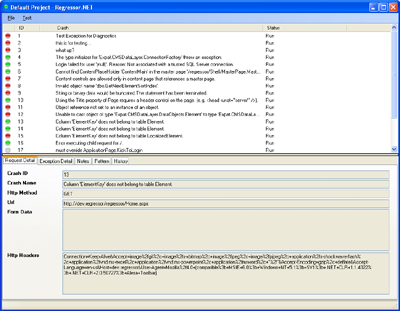
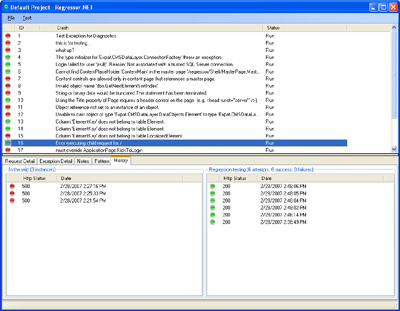
Here are a couple of quick screenshots to get a feel for how the Regressor GUI works. It's nothing fancy as you can see. Just enough information to let you dig down into your crash history, run regression test batches, and see what is still broken.
July 9
by
Jason Kester
Automated Crash Reporting and Regression Testing for ASP.NET
Regressor.NET is an add-in for ASP.NET applications that collects information about site crashes, and provides functionality to automatically resend the exact HTTP Request that caused any one of those crashes. For this reason, it is quite useful for Regression Testing, as it can be run in a batch mode to recreate every bad HTTP Request in the history of a Web Application.
Regressor.NET includes a graphical reporting console that can be used to view crash details and history reports, and to run Regression Tests individually and in batches. From this reporting console, it is possible to configure pattern matching settings to ensure that duplicate crashes are grouped together properly.
Automated Error Collection and Crash Reporting
Regressor.NET will automatically capture any page crashes on the target web site and store relevant information about the Exception and the HttpRequest that triggered it. This data is stored in a SQL Server database for use in Reporting and Regression Testing.
Automated Regression Testing
Regressor.NET collects information about site crashes, and provides functionality to automatically resend the exact Http Request that caused those crashes. It can be run for a single site crash, or in a batch mode that will re-run every Http Request that has ever crashed the website, essentially regression testing for every site crash in its stored history.
Integration with the NAnt build system
In addition to the Reporting Console and Command Line options, Regressor.NET can be run as an NAnt Custom Task, allowing it to perform regression testing as part of any NAnt-based build. For other build environments, a full-featured command line interface is provided.
Integration with the NUnit Unit Testing system
Regression tests can be exported as NUnit test cases, either via the GUI or automatically through the command line interface. An NUnit wrapper is provided to allow complete access to the Regression testing engine.
Implementation Details
Regressor.NET can be integrated into existing applications in two basic ways, either via a custom Base Page or through direct API calls from the Web Application. Regressor.NET provides a custom Page object, derived from System.Web.Page, that can be used as the base for any application pages, and will automatically detect and log unhandled exceptions. Alternately, Regressor.NET exposes a number of public methods that can be called to log exceptions manually.
Regression Testing is performed either through the graphical tools, via command line instructions, via automatically (or hand) generated NUnit unit tests, or as part of an NAnt custom task. Individual Crash Reports can be flagged as inactive for regression testing, for reasons such as long execution times, possible data corruption, etc.
For more information, or to volunteer as a beta tester, send email to info@expatsoftware.com
July 9
by
Jason Kester
